


As any self-respecting Bulgarian language learner would know, our language (just as much as our whole country) is a melting pot of many influences. Starting from food names, going to clothes, and locations, then phrases and idioms, we have done our fair share of cultural and language exchange with our neighbours… and not only!
 However, if you, dear reader, are not even a Bulgarian language learner (yet), we at Kristina Progress, would really like to show you the vast array of foreign words in our vocab, some of which we are so well accustomed to, that we wouldn’t even dare consider them borrowed! To show you how welcoming we are, and without being very witty, we’d like to invite you to join us on a small journey across the peculiarities of our language, and who knows… by the end, you might even learn how to repay us for the knowledge!
There aren’t many places as fun and friendly as the Balkans! In our corner of the world, we more often than not find ourselves talking to each other, between our beautiful countries, only to compare how many words in common we have, and what a joy it is to always keep discovering again and again how similar we are!
For example (and I dare you here!), try telling someone from Turkiye that:
“Баклава” – “Baklava”, “Сарми” – “Stuffed cabbage rolls”, “Кебап” – “Kebab”, “Патладжан” – “Eggplant”, “Суджук” – “Dried Sausage”, “Чорба” – “Soup”, “Кюфте” – “Meatball” are Bulgarian words!
Lo and behold, you’d very quickly discover that they might have a different opinion… and yet, instead of arguing, you’d all end up on a big table, having all of the above on it. Not necessarily in the aforementioned order!
You know what a true Bulgarian would exclaim! when they see that beautiful table full of food (or “трапеза” in our language)? Read carefully and repeat after me:
Ох, че кеф!
“Кеф”, is another word we use in our language A LOT, which comes from Turkish, where it ended up from the Arabic word “kayf”, which would mean pleasure, or simply being in a good state or mood. So the whole phrase “Ох, че кеф”, would altogether mean something like – “Eh, what a pleasure”.
Another very important component of “ох, че кеф” is, of course, the wine. While we’re on the subject of foods, we cannot really go without mentioning at least one iconic drink… and that would definitely be the wine / вино! Coming directly from Italy, this is the second most popular word we borrowed from our Mediterranean friends. The first one is even simpler – Ciao!
In Bulgaria when we say goodbye in an informal setting we simply wave and say “Чао”! However do not attempt to use this as a hello around here because it seems like we only half-borrowed it from the Italians…

Speaking about the Italians, images of beautiful beaches, mountains and endless hillsides might be invoked! However, do not think that we cannot offer similar locations to our guests, because in Bulgaria it has always been very popular to go to the “Курорт”! Yes, a direct borrow from the German word “Kurort”, the word is used to describe wonderful locations like Nessebar, Sozopol, Pamporovo and Bansko. You know, all the places where people keep saying – “Ох че кеф!”.
And it’s not just that – if you go to the supermarket you will be able to buy a “Вафла” – coming straight out of German “Waffel” – a sweet snack. On the streets, you will see a “Табела” – “Tafel” in German, or a street sign in English. The car’s exhaust is called “Ауспуф”, in German – “Auspuff”.
And of course, where would we be without the French?
You win a tournament? You get a “Трофей” – “Trophée”.
You sit at the desk? It’s a “Бюро” – “Bureau”.
You walk on the sidewalk (or pavement, if you drink tea in the afternoon) – it’s a “Тротоар” – “Trottoir”.
You drive to baba’s village? You are on the “Шосе” – “Chaussée”
Man, it seems like we have been busy…
Ok, after we’ve been through all sorts of topics, there’s one left untouched, and it’s both important, and sacred. That of course is religion. Our nation’s baptism happened more than a thousand years ago, and it came here with the kind support of Constantinople. So it is very logical to conclude that there’s been some serious Greek influence, especially linguistically. Let’s see:
On the weekend you go to the μοναστήρι… wait, that will make everything complicated here. Let me simply list them:
Манастир / Monastery – that’s where we go on the weekend.
Параклис / Chapel – that’s where we go to light a quick candle
Монах / Monk – that’s the person who lives in the monastery.
Парриарх / Patriarch – that’s the leader of the Orthodox church.
Апостол / Apostle – that’s a disciple of Christ.
Икона / Icon – that’s the image of a Saint, Apostle, Christ, etc.
Greek also gave us words like “Тиган”, which means a frying pan, and ‘Тетрадка”, which means a notebook.
We also should not forget some wonderful words that came from the East, long, long time ago, through Persian influence:
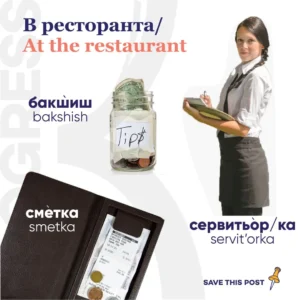
Words like “Бакшиш” – “Tip”, “Килим” – “Rug, Carpet”, “Джам”- “Window”, “Кехлибар” – “Amber”, “Шадраван”- “Fountain”, “Туршия” – “Pickled salad”, “Серсем” – “Fool”,“Пазар” – “Market”, “Чешма” – “Water fountain”.
These not only reflect the cultural ties between our ancient nations, but also the linguistic influence of the time period it came in. Speaking about time, as we have entered the XXI century, where all sorts of tech and pop-culture is coming from the West, let’s see where English comes into play, with words like:
 “Компютър” – “Computer”, “Бизнес” – “Business”, “Мениджър” – “Manager”, “Сайт” – “Site”, “Чат” – “Chat”, “Блог” – “Blog”, “Имейл” – “Email”, “Скенер” – “Scanner”, “Принтер” – “Printer”, “Уикенд” – “Weekend”, “Офис” – “Office”, “Лайквам” – “To like”, “Фен” – “Fan”, “Бранд” – “Brand”, “Бестселър” – “Bestseller”, “Дизайн” – “Design”, “Файл” – “File”…
The list is endless.
So here we are, our dearest reader, we have reached the end of this little journey through time and language. We hope that once again you had a blast with us, and as we promised we will let you know how you can repay it for all this knowledge. When (not if!), the time comes for you to pick up the study books and embark on the quest to learn Bulgarian, let us help you! We have a lot to offer, and without being too proud – we do it very well!
Now, take this one last phrase, and say it to someone, next time they ask for free advice:
“За мерси, не ме търси!” – “Do not call me (and ask for help) for a merci!”
Чао, and мерси for the attention!